Fighting the Burmese Python In Everglades National Park 


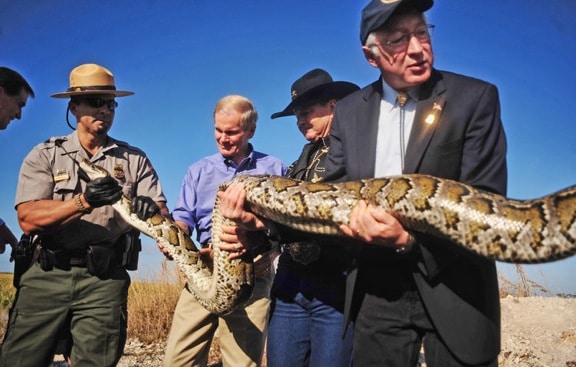
The United States recently announced a ban on importing Burmese Pythons and transporting the snakes across state lines.  U.S. Interior Secretary Ken Salazar made the announcement at a flood control pumping station near the Florida Everglades with Florida Senator Ben Nelson and Florida Wildlife Commission officials as they held aloft a recently captured 13-foot python.  The ban also affects the yellow anaconda and northern and southern African pythons.


The Burmese python is the most prevalent “invasive species” in subtropical Florida.  Native to southeast Asia and  considered one of the six largest snakes in the world, Burmese pythons are one of many invasive species that start out as seemingly harmless pets.  At a young age, pythons can measure less than a foot in length.  But within a matter of years, they typically grow to be 12 feet long, and in some cases closer to 20 feet.  The enormity of the snakes, and the effort involved in caring for one, has led many pet-owners to let their pythons loose in the wild.
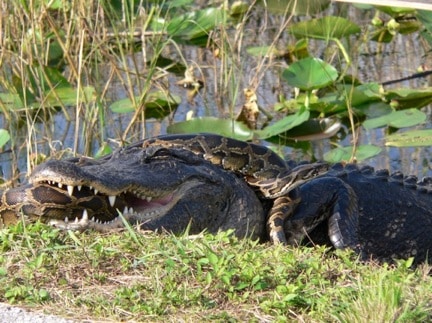


The increasing disposition of the pythons to the Everglades has led to an overabundance of pythons that the fragile ecosystem simply cannot handle. Producing an average of 12 to 36 eggs per female each year in March and April, needless to say the species is thriving.  According to the US Natural Park Service, over 1330 Burmese Pythons had been captured by the end of 2009, and the numbers seem to be getting worse each year.  Their diet often consists of endangered birds and mammals, but pythons are known to have attacked and eaten alligators, as well as swallowing entire deer.


A February 2008 report published by US Geological Survey scientists concluded that, by the end of the 21st century (based on global warming predictions and climate modeling for the snakes’ natural habitat), Burmese Pythons could migrate and flourish in one-third of the continental United States.  Although a more recent study using different ecological modeling has attempted to contradict this claim, the Pythons’ growing numbers in Florida is worrisome.  Hopefully the recent ban is enough to halt the species’ rapid territorial expansion and keep the already fragile Everglades ecosystem intact.  –Raffi Simel

If you enjoyed reading about the Burmese Python In Everglades National Park, you might also like:

Sanibel Island Eco Activities

Swimming with Manatees In Crystal River, Florida

2 Responses to ECO NEWS: Fighting the Burmese Python In Everglades National Park

  • Susane says:

    OMG! These phytons are really huge. Eating an alligator like that seems unreal. I would certainly not enjoy meet one of these

  • Oh, we’re reptile keepers (well Matt is anyway, me not so much!) and so he and the kiddos watch a lot of documentaries about reptiles and other animals, and we’ve watched a few that have talked about the problem with exotic animals in the US, and specifically the Burmese Python.

    I was actually surprised that there was such little control over exotics in the US. There tend to be tough guidelines here, not that it stops smuggling, but we don’t tend to have the same sort of problems. Makes me feel for the native animals, just another way us humans are making it tough on our own environment to stay sustainable!!!

Leave a Reply

Your email address will not be published. Required fields are marked *

You may use these HTML tags and attributes: <a href="" title=""> <abbr title=""> <acronym title=""> <b> <blockquote cite=""> <cite> <code> <del datetime=""> <em> <i> <q cite=""> <strike> <strong>

CommentLuv badge

Co-Founded by Bret Love & Mary Gabbett, Green Global Travel is an ecotourism, nature / wildlife conservation & cultural preservation magazine. More about us.

Help Support Green Global Travel!

Each time you make a purchase on Amazon.com using the link below,we'll earn a small percentage, at no extra cost to you.


Amazon

www.amazon.com

Thanks for your support! - Bret & Mary

Follow Us

Destinations We’ve Covered:

• AFRICA
Egypt- Top 5 Eco Attractions
South Africa- Londolozi Game Reserve Safari
South Africa- Kruger National Park
South Africa- South Africa- Zulu Memories
Tanzania- Climbing Mt. Kilimanjaro

 
• ANTARCTICA
How To Get To Antarctica Without Doing the Drake
Penguins of Antarctica
Taking the Polar Plunge
Top 5 Eco Attractions in Antarctica
Whales in Antarctica
 
• ASIA
India- Ranthambhore National Park
Laos- The Pastoral Paradise of Muang Ngoi
Nepal- Hiking The Annapurna Circuit
Taiwan- Top 5 Eco Activities in Taipei
 
• AUSTRALIA/OCEANIA
Australia- Top 5 Eco Attractions
Australia-Kangaroo Island
New Zealand- Kapiti Island
New Zealand- Tongariro National Park
Tahiti- First Impressions
Tahiti- Moorea, Tiki Village Theater
Tonga- Eua Island Eco Activities


• NORTH AMERICA
CANADA
Churchill- Into the Wild of Manitoba
Churchill- Polar Bear Fight
Churchill- Polar Bears
Churchill- Tundra Wildlife

UNITED STATES
America’s Best Volcanoes
AK- Denali National Park
FL- Sanibel Island Eco Activities
FL- Crystal River, Swimming with Manatees
GA- Barnsley Gardens
GA- Belugas at Georgia Aquarium
GA- Best Christmas Light Displays
GA- Jekyll Island Eco Activities
GA- Weekend in North GA Mountains
GA- Top 5 Eco Attractions in North GA
HI- Hawaii’s Big Island
HI- Hawaiian Mythology
MT- Glacier National Park
NC- Greensboro Travel Guide
NM- Top 5 Eco Attractions
NY- Going Green in NYC
WV- Outdoor Adventures
Yellowstone- Mammoth Hot Springs
Yellowstone- Lamar Valley
Yellowstone- Grand Canyon & Hayden Valley
Yellowstone- Upper Geyser Basin
Yellowstone- Lower Geyser Basin

MEXICO
Riviera Maya- Monkeys, Pyramids & Pottery
Riviera Maya- Tulum & Coba
 
• CARIBBEAN
