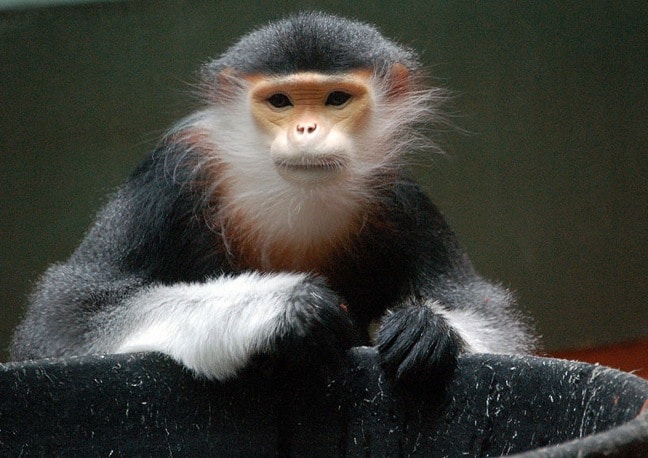
Grey-shanked douc, by Art G via Creative Commons

Photo by Art G via Creative Commons


SPECIES-  Gray-Shanked Douc Langur  (Pygathrix Cinerea)

CURRRENT RANGE-  Central Vietnam

CURRENT THREAT- Habitat Loss, Hunting

CURRENT STATUS-  Critically Endangered

WHERE YOU CAN SEE THEM-  Wooded habitats in Vietnam

WHAT IS IT?

The douc langur is a primate that comes in three species– gray-shanked, red-shanked and black-shanked— and it’s equally breathtaking to watch at a standstill and in motion. Arboreal by nature, the douc (an ancient Vietnamese word thought to mean “monkey”) swings through the forests of Vietnam in groups of 4-15. While each species has a tail about the same length as its body (56-76 centimeters), the endangered red-shanked has a maroon-like hue running from its knee to ankle. The black-shanked douc, also endangered, has a greyish-blue face. The critically endangered gray-shanked douc has a golden face, white chin and gray coat covering most of its body.
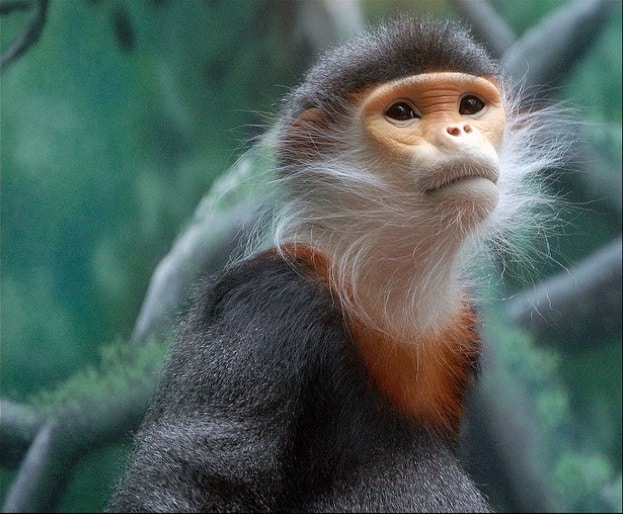
 

Grey-shanked douc, by Art G via Creative Commons

Photo by Art G via Creative Commons


WHY ARE THEY ENDANGERED?

Because of their colorful hair, doucs are occasionally called “costumed apes.” Sadly, little about the vibrant mammal’s past 30 years has offered much to cheer about. During the Vietnam War, soldiers reportedly used the douc for shooting practice, drastically reducing the species’ population. Today, humans remain the chief reason numbers of the gray-shanked douc have plunged to around 600. Due to illegal logging, forests are disappearing at an alarming rate. And then there are hunters, who sell the animals as food, medicine and exotic pets, who are still very much on the prowl. In fact, on July 26 three Vietnamese soldiers were arrested for the brutal torture and killing of two gray-shanked doucs after one of the men, Nguyen Van Quang, posted a disturbing series of photos of the heinous act on his Facebook page.


WHAT”S BEING DONE TO SAVE THEM?

Global response to the douc’s decline has been profound. The WWF is working in Southeast Asia to conserve the natural ecosystems through the Greater Mekong Programme. The Frankfurt Zoological Society spearheads the Vietnam Primate Conservation Programme, whose objective is to protect the langur in the country. There are also a host of other smaller dedicated outfits like the Douc Langur Foundation, an organization that gathers locals to confiscate doucs, disarm wire traps and raid markets, restaurants and private homes that benefit from the animal’s capture. If there’s any upside to the recent uproar over the douc torture and killing in Vietnam, it’s that interest in saving the adorable primate species has never been higher.  –DeMarco Williams

5 Responses to ENDANGERED SPECIES SPOTLIGHT: Gray-Shanked Douc Langur

  • Jeremy says:

    I wish I could grow a beard like that!

    • founders says:

      They do look pretty awesome, don’t they? My beard just keeps getting more grey and scraggly as I get older. The thing they never tell you about salt and pepper hair is that the “salt” grows faster and coarser than the pepper!

    • founders says:

      They do look pretty awesome, don’t they? My beard just keeps getting more grey and scraggly as I get older. The thing they never tell you about salt and pepper hair is that the “salt” grows faster and coarser than the pepper!

  • Dr. Whalen says:

    The douc langur has such a gentle face, don’t you agree? Maybe that’s why they’re called “costumed apes”. It almost seems human.

    • founders says:

      Agreed, Dr. Whalen. I’ve always been fascinated by primates, and could watch their facial expressions for hours. Hope to see these in the wild someday.

Leave a Reply

Your email address will not be published. Required fields are marked *

You may use these HTML tags and attributes: <a href="" title=""> <abbr title=""> <acronym title=""> <b> <blockquote cite=""> <cite> <code> <del datetime=""> <em> <i> <q cite=""> <strike> <strong>

CommentLuv badge

Co-Founded by Bret Love & Mary Gabbett, Green Global Travel is an ecotourism, nature / wildlife conservation & cultural preservation magazine. More about us.

Help Support Green Global Travel!

Each time you make a purchase on Amazon.com using the link below,we'll earn a small percentage, at no extra cost to you.


Amazon

www.amazon.com

Thanks for your support! - Bret & Mary

Follow Us

Destinations We’ve Covered:

• AFRICA
Egypt- Top 5 Eco Attractions
South Africa- Londolozi Game Reserve Safari
South Africa- Kruger National Park
South Africa- South Africa- Zulu Memories
Tanzania- Climbing Mt. Kilimanjaro

 
• ANTARCTICA
How To Get To Antarctica Without Doing the Drake
Penguins of Antarctica
Taking the Polar Plunge
Top 5 Eco Attractions in Antarctica
Whales in Antarctica
 
• ASIA
India- Ranthambhore National Park
Laos- The Pastoral Paradise of Muang Ngoi
Nepal- Hiking The Annapurna Circuit
Taiwan- Top 5 Eco Activities in Taipei
 
• AUSTRALIA/OCEANIA
Australia- Top 5 Eco Attractions
Australia-Kangaroo Island
New Zealand- Kapiti Island
New Zealand- Tongariro National Park
Tahiti- First Impressions
Tahiti- Moorea, Tiki Village Theater
Tonga- Eua Island Eco Activities


• NORTH AMERICA
CANADA
Churchill- Into the Wild of Manitoba
Churchill- Polar Bear Fight
Churchill- Polar Bears
Churchill- Tundra Wildlife

UNITED STATES
America’s Best Volcanoes
AK- Denali National Park
FL- Sanibel Island Eco Activities
FL- Crystal River, Swimming with Manatees
GA- Barnsley Gardens
GA- Belugas at Georgia Aquarium
GA- Best Christmas Light Displays
GA- Jekyll Island Eco Activities
GA- Weekend in North GA Mountains
GA- Top 5 Eco Attractions in North GA
HI- Hawaii’s Big Island
HI- Hawaiian Mythology
MT- Glacier National Park
NC- Greensboro Travel Guide
NM- Top 5 Eco Attractions
NY- Going Green in NYC
WV- Outdoor Adventures
Yellowstone- Mammoth Hot Springs
Yellowstone- Lamar Valley
Yellowstone- Grand Canyon & Hayden Valley
Yellowstone- Upper Geyser Basin
Yellowstone- Lower Geyser Basin

MEXICO
Riviera Maya- Monkeys, Pyramids & Pottery
Riviera Maya- Tulum & Coba
 
• CARIBBEAN