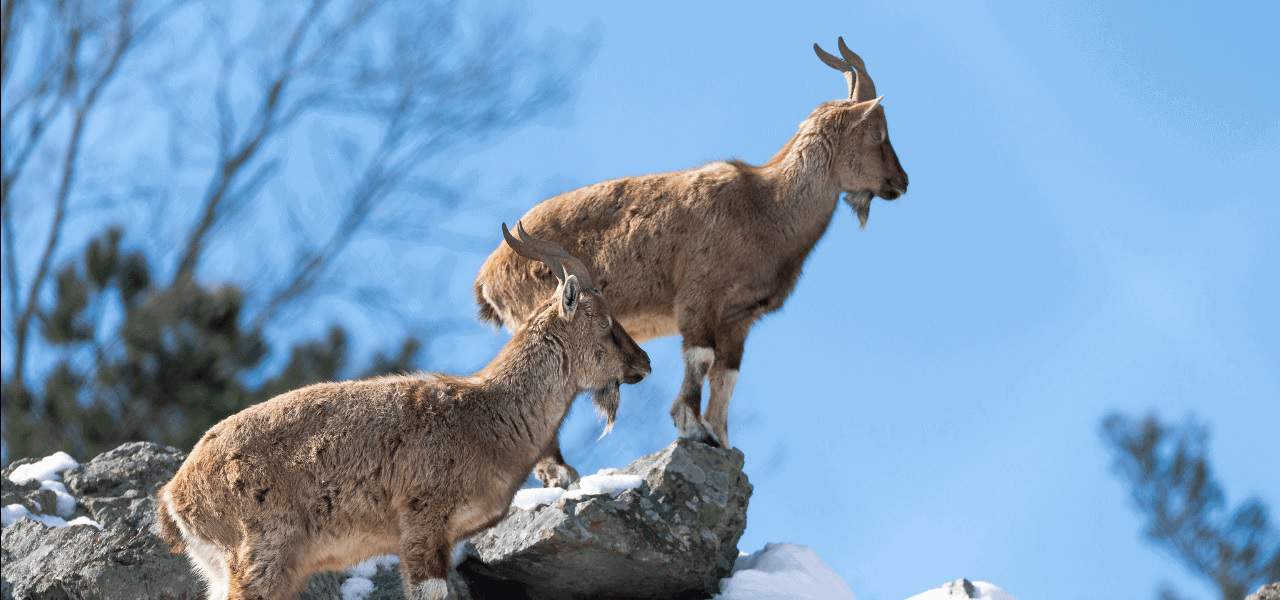
Over the last 8 years of running Green Global Travel, there’s been an unfortunate amount of bad news to report for nature and wildlife. But the comeback of the markhor– the National Animal of Pakistan– from the brink of extinction has been one of the world’s great (but little known) conservation success stories.
When we first wrote about this impressively horned wild goat in 2011, the population in its native range (which includes mountainous regions of Afghanistan, India, and Pakistan) had shrunk to around 2,500 individuals.
Back then, the situation for the endangered species was looking incredibly bleak. Trophy hunters wanted the markhor’s long, spiraling horns for their display case. Locals wanted the 200-pound animals meat for food.
Some traditional Chinese medicine practitioners sought out the animal for its purported healing powers. With man’s steady encroachment, the markhor was also fighting domestic livestock for food.
But that was before five protective sanctuaries were created in the northern Indian state of Jammu and Kashmir (where markhor numbers had dipped to less than 400).
Conservation initiatives from wildlife NGOs like Save Our Species and WCS Pakistan were put into place. Once completely legal in Pakistan, markhor hunting licenses were limited to just 12 per year.
Thanks to these changes, the majestic mammals gradually began to rebound. Over the course of a decade, their population grew by an incredible 20%.
In 2015, the International Union for the Conservation of Nature removed the markhor from its Endangered species list and downgraded it to Near Threatened. It was a huge win for an animal scientists believe may be the ancestor of many modern domesticated goats.
Here’s an in-depth look at 40 fascinating facts about the three markhor subspecies, covering everything from their bodies and behavior to mating, parenting, and conservation.
- Markhor Bodies
- Markhor Behaviors
- Markhor Mating & Parenting
- Markhor Conservation
- Other Markhor Facts
MARKHOR BODIES
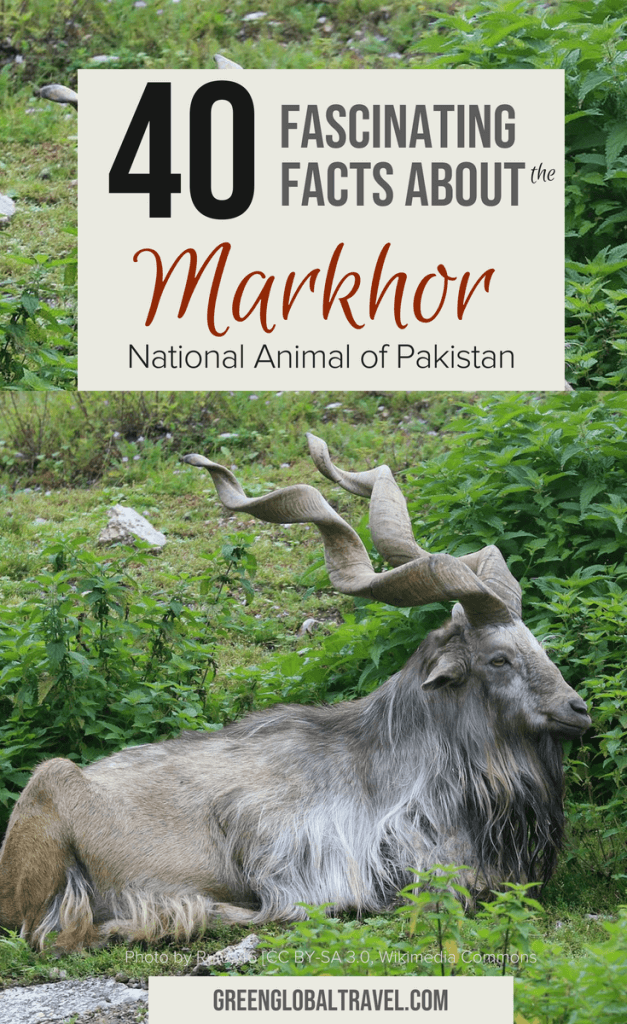
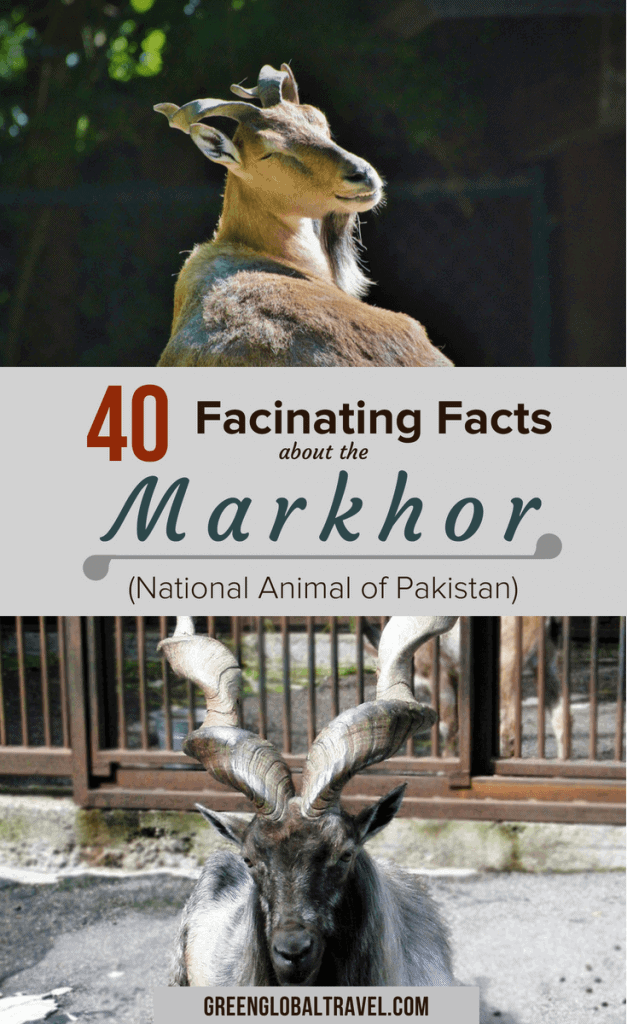
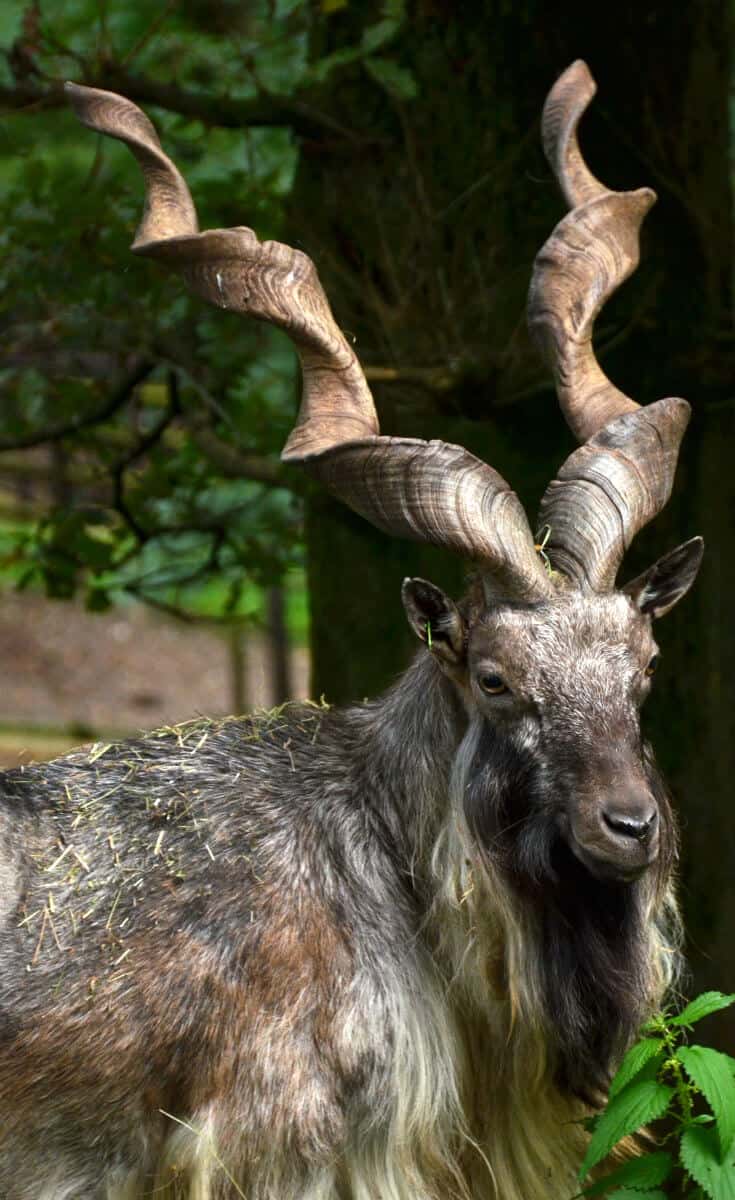
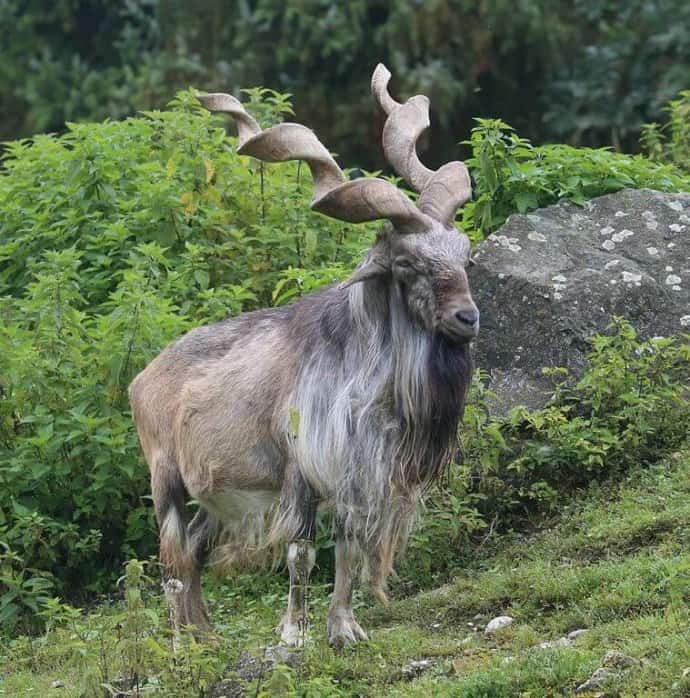
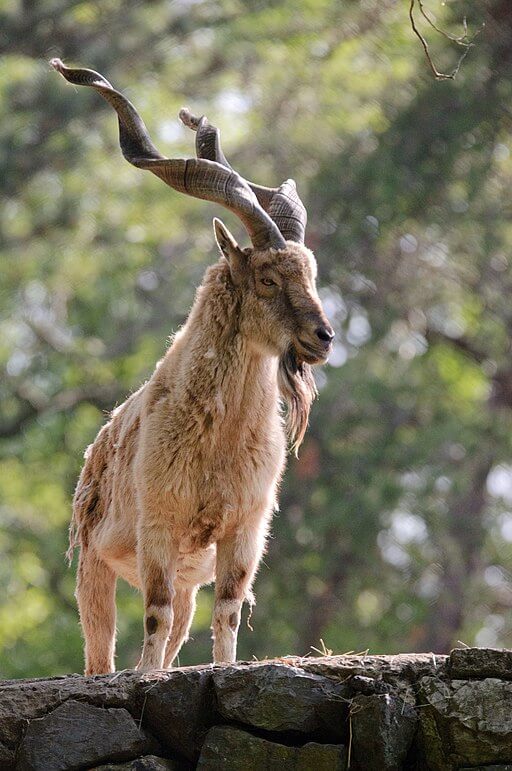
1) Male markhors are massive. They can grow to well over 200 pounds, have an exaggerated amount of hair extending from their chin/chest and, most notably, have spectacular spiraling horns atop their heads. Females’ horns are less dramatic, their throats are less hairy, and their bodies a lot less stout. However, both sexes graze on grass and live in mountain elevations as high as 3,000 meters.
2) There are three subspecies– the flare-horned markhor, the Kabul (or straight-horned) markhor and the Bukharan markhor– which can be differentiated by the shape and extension of their horns. But even though there are subtle differences between them, these species all look more or less the same.
3) The flare-horned or Astor markhor has horns that split and face two different directions, resembling an opened banana peel. This subspecies is the most widespread of the three, with the largest population. It can be found in India, Pakistan, and Afghanistan.
4) The straight-horned (or Kabul) markhor has horns that stand straight up from their head, but they are spiral-shaped. These markhors can be found in Pakistan and Afghanistan, and it is Though named for the capital of Afghanistan, these days the Kabul markhor is primarily found in the mountains of Balochistan Province, Pakistan. This is thanks in large part to the Torghar Conservation Project, a partnership between tribal leaders, local communities, and the U.S. Fish & Wildife Service.
5) The Bukharan markhor is the most familiar-looking of the three subspecies, with its impressive twisted horns (which unfortunately make them a target for trophy hunters). They’re native to Afghanistan as well as neighboring central Asian countries, including Tajikistan, Turkmenistan, and Uzbekistan.
READ MORE: Indian Animals (A Guide to 40 Incredible Indian Wildlife Species)
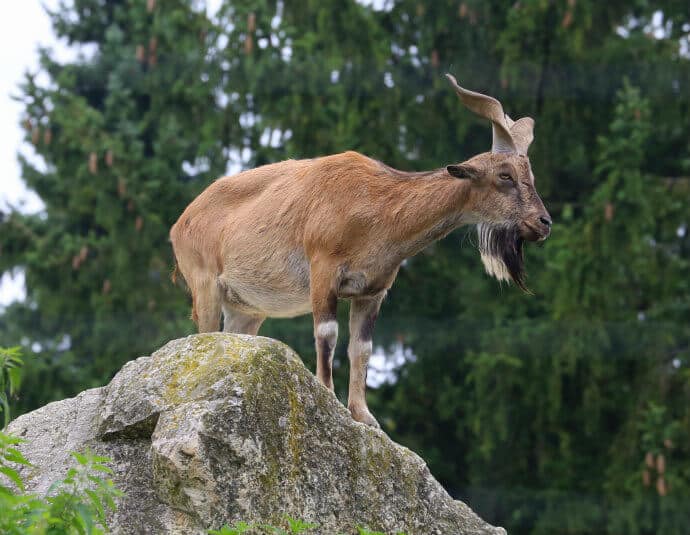
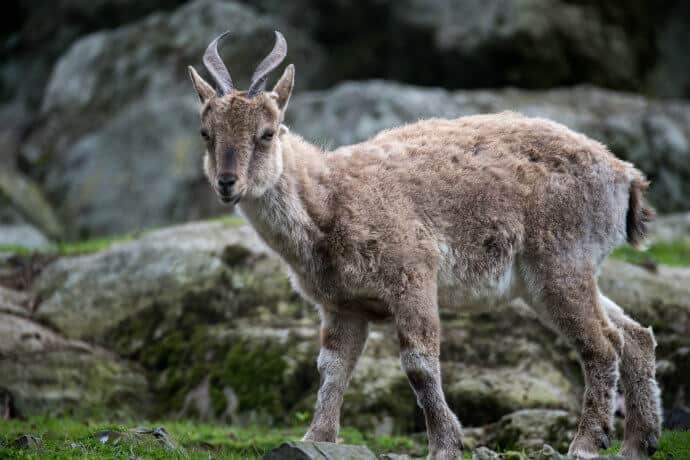
6) Markhors are “sexually dimorphic,” meaning that the male and female species do not look exactly the same and are easily distinguishable from one another. For markhors, the biggest difference is seen in their size, with males weighing twice as much as females. While both have beard-like hair, the male markhor’s hair is considerably longer and thicker.
7) Living in the mountainous terrain requires the ability to move up and down the hilly, often rocky terrain. Despite their large size, markhors are extremely skilled climbers. These gorgeous goats can even climb trees and other slanted structures, including seemingly dangerous cliffs, in order to forage for food and evade predators.
8) The coats of Markhors come in a few standard colors. Usually their bodies are tan or grayish, with white chests and underbellies. But sometimes this coat is a reddish color. Their legs are black and white and their faces are dark. The horns of a markhor can range in color as well, so these creatures do not all look exactly the same in every season.
9) Just as we humans wear different clothes for different seasons, a markhor’s coat grows and sheds depending on the time of year. In warmer months the animal sheds so that its fur becomes less dense, whereas in the winter it grows longer and thicker to insulate the markhor’s body.
10) Another useful genetic adaptation these animals have is their feet. The hooves of the markhor are wide, helping them balance when climbing or simply walking in their often uneven habitat. This wide stance helps them avoid wobbling, so they do not fall off their mountain homes!
READ MORE: Saving Asian Animals (The Best Wildlife Conservation Programs)
MARKHOR BEHAVIORS
11) Some animals are more extroverted than others, but the markhor can be either social or solitary depending on their sex. Female markhors usually travel in small herds containing 8 to 10 members, and are generally very social with one another. Male markhors, on the other hand, spend most of their time alone when they’re not trying to mate.
12) Male markhors use their horns when fighting for females during mating season. But there are lots of other practical uses for these stunning horns as well: They use them for digging in the ground and to remove bark from trees. Much like the rings on a tree, there are rings on a markhor’s horns that can tell you how old the animal is.
13) Strong senses are vital for prey animals such as the markhor to survive in the wild. To help them avoid predators, markhors have extremely keen, senses of sight and smell. Both abilities help them to detect predators from a distance as well as recognize their home territory.
14) The markhor’s preferred mountain habitat has quite a few major predators, including big cats like snow leopards and lynxes as well as wolves. Occasionally, even golden eagles have been observed to hunt younger markhors as well.
15) In order to eat, markhors will go to great lengths… or, in this case, heights! Not only can they stand on their hind legs to reach for their food, but markhors have been known to climb trees in order to reach the tastiest bits. It may be a bit bizarre to see a goat scamper up a tree or stretch upwards on two legs, but it’s a strategy that clearly works for this species.
READ MORE: 60 Weird Animals Around the World
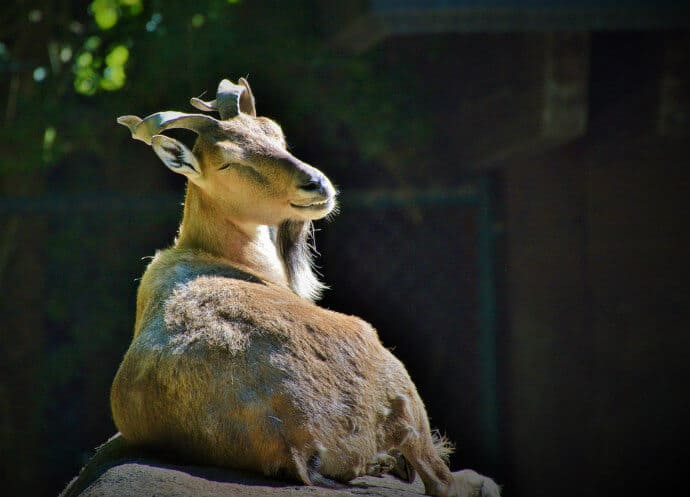
16) Feeding is serious business for markhors, and takes up a considerable amount of time. These herbivores spend more than half their day grazing, about 12-14 hours on average! They mostly feed on grass in the warmer months. But once winter arrives they switch to other plants, including shrubs and twigs, since grass does not grow as easily in the cold.
17) When they’re not busy feeding, these animals like to rest as well. They usually forage for food in the early morning and late afternoon, and can often be seen lazing about and chewing their cud in the middle of the day. This propensity for being active twice a day makes the markhor a diurnal species.
18) Markhors may know how to climb, but, as the old saying goes, “what goes up must come down.” In the frigid winter months, markhors retreat to a lower elevation in order to avoid foraging in the snow. Once it warms up and everything melts, they head back up into higher elevations again.
19) As natives of the mountains of Asia, markhors typically live at elevations ranging from 600 to 3,600 meters (1969-11,811 feet). The prefer to live in areas with some degree of foliage, such as oak trees, with other favorite varieties being pine, juniper, and fir. But they usually do not travel higher than the tree line, in order to keep an open watch for predators.
20) Although markhors are substantially larger than typical goats, they are very similar in the sounds they make. The “alarm call” of the markhor sounds much like that of a common goat, showing a commonality between the two related species despite some major differences.
READ MORE: The 20 Best Mountains in the World (World Travel Bucket List)
MARKHOR MATING & PARENTING
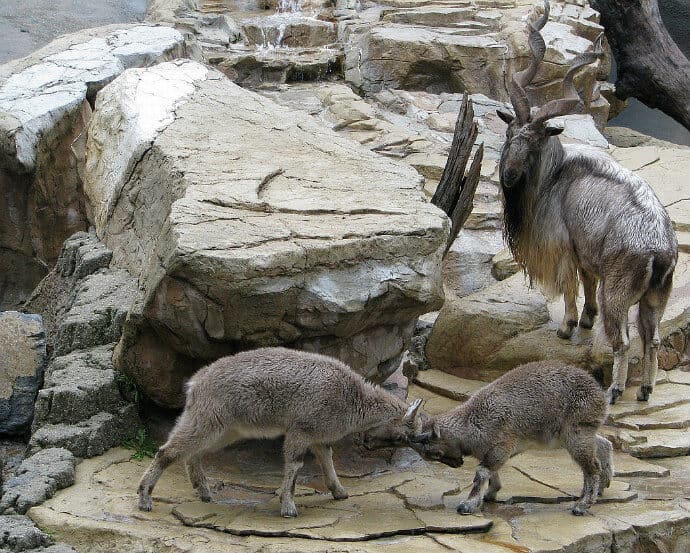
21) Male markhors’ feisty sides come out during mating season. To win the desired female’s interest, her male suitors will fight aggressively by interlocking horns and wrestling until one of them falls over. The last male standing wins the prize!
22) Breeding patterns for markhors are much like those of typical goats. The gestation period for pregnant female markhors is 135 to 170 days– about half as long as a human pregnancy. Markhors breed only once a year, usually giving birth to one or two “kids.”
23) Unlike many other animals, markhor mating typically occurs in the winter (rather than the spring). Babies are usually born in a shallow hole in the ground sometime between late April and early June. They’re able to walk quite soon after being born, and travel with their mother fairly quickly.
24) Mothers provide all the nourishment (milk) and protection for their kids, with male markhors taking no role in parenting. The young are weaned at an age of 5 to 6 months, but some kids will remain with their mothers for considerably longer if they’re not ready to venture out on their own.
25) There’s a stark difference in the age of maturity between male and female markhors. Female markhors reach sexual maturity more than twice as early as males, with females being sexually mature at 2 years old and males at 5 years old. This could explain why the males spend so much time alone!
READ MORE: 20 Wildlife Species That Mate for Life
MARKHOR CONSERVATION
21) When GGT first wrote about the markhor back in 2011, the world’s population was down to around 2,500 adults. In the northern Indian state of Jammu and Kashmir, the number was uncomfortably sitting around 400. The species was considered Endangered until 2015.
22) Thankfully those numbers have started to bounce back in recent years due to improved conservation efforts. The markhor is currently labeled as “near threatened” by the IUCN Red List of Threatened Species, with a total population of less than 10,000 worldwide.
23) Humans are the main predators of the markhor due to the desire for their remarkable horns. They are frequent victims of trophy hunting, a scourge that’s also affecting beloved animals such as elephants (which are hunted for their ivory tusks) and rhinos (which are hunted for their horns). Although hunting the markhor is illegal in Afghanistan, India, and Pakistan (see exceptions below), poaching still occurs and their horns are subsequently sold on the black market.
24) Although hunting markhors is mostly illegal, the government of Pakistan does issue four permits to hunt each of the three subspecies of Markhor every year. So there’s a total of 12 markhor hunting licenses sold annually, in open auctions. The proceeds are supposedly used to fund conservation efforts.
25) Markhors are also threatened due to the dwindling of their preferred habitats. Since the 1980s, their home in Pakistan has experienced ever-increasing deforestation for a number of reasons, including logging for fuel and building materials, coal mining, and overgrazing of domestic livestock. This has substantially decreased the markhor’s grazing area, which makes their food sources more scarce.
READ MORE: The Meaning of The Lorax (10 Lessons From Dr. Seuss’s Classic)
26) Poaching and habitat loss aren’t the only causes of concern for the markhor population. These animals are also susceptible to certain diseases that are often contracted from goats. Caprine Pleuropneumonia (CCPP) has spread from domesticated goats to the markhor in recent years. Cross-breeding also contributes to a reduction of the population, since goats and markhors often compete for food.
27) Markhors are sometimes sought out by humans for medicinal purposes. In traditional Chinese medicine, their ground up horns have long been thought to possess healing properties, and are used to treat various maladies.
28) Markhors have historically been hunted primarily for their meat. Goat meat is eaten throughout many countries in southern Asia, and a 200-pound wild goat could provide quite a lot of sustenance for people who do not have easy access to other types of meat.
29) When the British occupied India (which then included modern-day Pakistan as well), hunters detailed the difficulties of trying to hunt the markhor. The fact that the animals lived high in the mountains west of Ladakh made tracking them problematic. And the treacherous conditions of the Northern Indian winter made it hard to hunt for anything, much less an agile goat adept at hiding in the mountains.
30) These days, all of the markhor subspecies are protected by strictly monitored, community-based conservation programs. Since poaching is severely punished, it is almost nonexistent now.
READ MORE: 7 Harmful Traditional Practices Tourists Should Never Support
OTHER MARKHOR FACTS
31) The markhor (which is also known as the shakhawat) is the national animal of Pakistan, most likely because it can be found in several different regions throughout the country. In 2018, Pakistan International Airlines formally rebranded and added a markhor image to the tail of every plane.
32) It’s thought that the animal’s name from the Persian words mar (meaning “snake”) and chore (meaning “eater”). The origin of this name is unknown, but most likely it’s because male markhors have been known to stomp on snakes in order to kill them. But they don’t eat them (they’re herbivores, remember?); they’re just protecting their harems of females from danger.
33) Like cows, markhors can often be found chewing their cud after eating. In the process of chewing, the cud often falls out of their mouths and onto the ground. Locals insist that this substance is helpful for treating snake bites and other wounds, so it’s popular among people who prefer natural remedies.
34) The lifespan of the markhor depends entirely on the environment in which it lives. Wild markhors usually live around 12 to 13 years, while those in captivity have been known to live up to 19 years. This is because markhors in the wild are subject to the aforementioned threats (predators, deforestation, poaching, etc).
35) The male markhor’s horns can grow up to 5 feet, 4 inches, which is taller than many humans! The female’s horns tend to grow much shorter, to a length of about 10 inches. This discrepancy in horn length makes it easier to tell the difference between male and female markhors.
37) According to at least one scientist from the 1850s, male markhors have an unpleasant smell that’s even worse than that of a typical domestic goat. This sort of adaptation could be helpful for warding off predators or marking their territory, and it could also help people to detect them from a distance. So if you’re going to be in the vicinity of a markhor anytime soon, prepare yourself for some serious stink!
38) Scientific research is currently being conducted in order to determine how closely related the markhor is with other goat species. This research can help scientists figure out how the different species interact with one another and their environments. Legendary naturalist/biologist Charles Darwin postulated that modern goats arose from crossbreeding the markhor with wild goats.
39) Some researchers believe that the markhor may be the ancient ancestor of some popular domesticated goat breeds around the world. These include the Angora goat, the Changthangi goat of Ladakh and Tibet, the Girgentana goat of Sicily, the Bilberry goat of Ireland, and various Egyptian goat breeds.
40) Can’t make it to the Himalayas in order to see the markhor in the wild? Numerous zoos around the world have these massive goats, including the Calgary Zoo (Canada), Tatakuti Wildlife Sanctuary (India), the Bronx and Rosamond Gifford Zoos (New York), Los Angeles Zoo (California), Columbus Zoo (Ohio), and Stone Zoo (Massachusetts). –Anika Chaturvedi & Bret Love
If you enjoyed reading about the Markhor, you might also like:
Inspirational Animal Rights Activists (15 Female Heroes)
40 Amazing Costa Rican Animals That Will Make You Want To Visit Now
40 Animals in Kenya: A Guide t0 Kenyan Wildlife
30 Amazing Galapagos Island Animals
The Problem with Animal Selfies
40 Green Travel Tips (The Ultimate Guide To Sustainable Travel)
What Is Ecotourism? (The History & Principles of Responsible Travel)
Featured photo of Two Markhor on Snowy Rocks (cropped) by Eric Kilby via CC 2.0