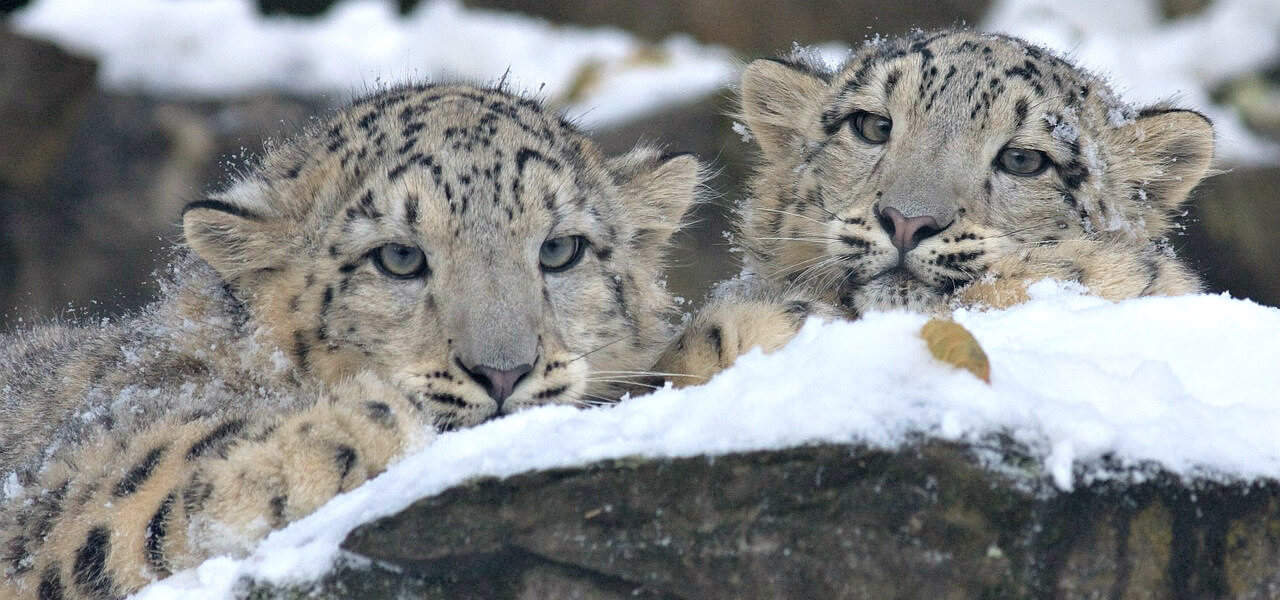
Normally, when we think of Leopards, we tend to think of fierce predators in hot climates– places like Kenya, Tanzania, and Southern Asia.
You might know that Leopards are incredibly strong, able to pull prey much larger than they are up a tree. You might also think of black spots on yellow fur.
In short, most of us do not usually think of Snow Leopards.
As a species (Pantera pardus), Leopards have several subspecies that are currently listed as endangered by the IUCN: Amur Leopards, Javan Leopards, South Arabian Leopards, Central Asian Leopards, and Sri Lankan Leopards.
Though they are included on the IUCN Red List as vulnerable, with a population that is steadily decreasing, the Snow Leopard (scientific name Panthera uncia) is not actually a Leopard at all.
Truth be told, there’s not really any other big cat on the planet quite like them.
READ MORE: 40 Fascinating Facts About the Amur Leopard
Snow Leopard Information
- Basic Snow Leopard Facts
- Snow Leopard Habitat
- Snow Leopard Diet
- Snow Leopard Babies/Mating
- Why Are Snow Leopards Endangered?
- Snow Leopard Conservation
Basic Snow Leopard Facts
1. Though they may look like Leopard ghosts, genetic tests link Snow Leopards more closely to Tigers. Strangely, their scientific name (which was recently changed from Uncia uncia) was originally used to describe the European Lynx, and is derived from the old French word for “once.”
2. There are many subspecies of Tigers (South China, Sumatran, Amur, Indochinese, etc.), as well as Lions (Asiatic, Barbary, West African, etc.). But until 2017 there was only one Snow Leopard species. Now there are three subspecies: P. u. uncia, P. u. uncioides, and P. u. irbis.
3. Snow Leopards are the only classified large Panthera species that cannot roar. Instead, Snow Leopard sounds include the chuff, growl, hiss, and mew.
4. Like all cats, Snow Leopards are mammals– part of the Felidae (feline) family. They are in the Panthera genus, which also includes Jaguars, Leopards, Lions, and Tigers. The other two “big” cats, Cheetahs and Pumas, are part of the Puma genus.
5. So just how big is a Snow Leopard? Most individuals weigh between 60 and 120 pounds, measuring at around two feet tall and four to five feet long. While they are large mammals, this makes them the smallest of the big cat species.
READ MORE: Fascinating Facts About the Iberian Lynx
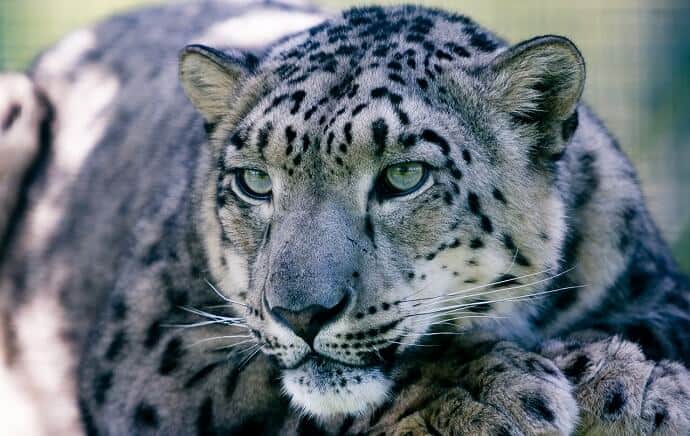
6. Female Snow Leopards are generally about two-thirds the size of males.
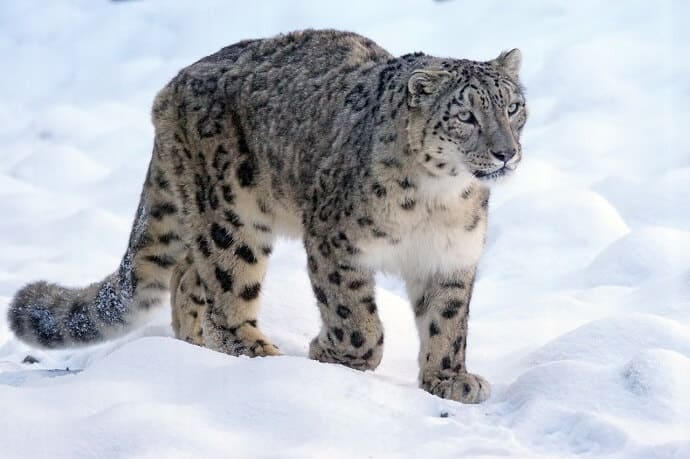
7. Snow Leopards have evolved to make their bodies better suited to their frigid habitat. So they’re stocky cats with short legs and short, rounded ears that help prevent the loss of body heat. They also have wide nasal cavities to heat the air they breathe before it reaches their lungs.
8. Snow Leopard fur is incredibly thick– up to five inches– to better insulate them in the snow. This fur also covers their large paws, which function almost like snowshoes to make it easier for them to walk and stalk their prey in the snow.
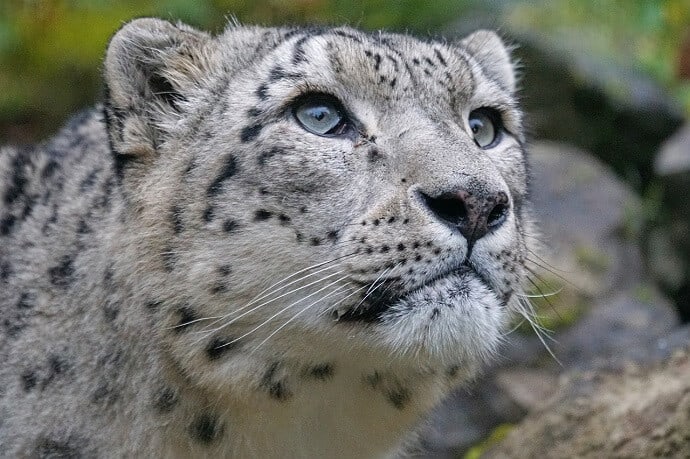
9. This thick Snow Leopard coat is colored to match the icy environment. Typically, they have a white-gray coat with black rosettes that provide the ideal camouflage, and their belly is pure white.
10. Another intriguing adaptation is that the Snow Leopard’s tail is exceptionally long (around 3 feet) and large compared with other cats. This is because they use their tails to cover sensitive areas to keep them warm. Their tails also work as fat storage for times when food is more difficult to find.
READ MORE: Endangered Asian Animals (10 Best Conservation Programs)
Snow Leopard Habitat
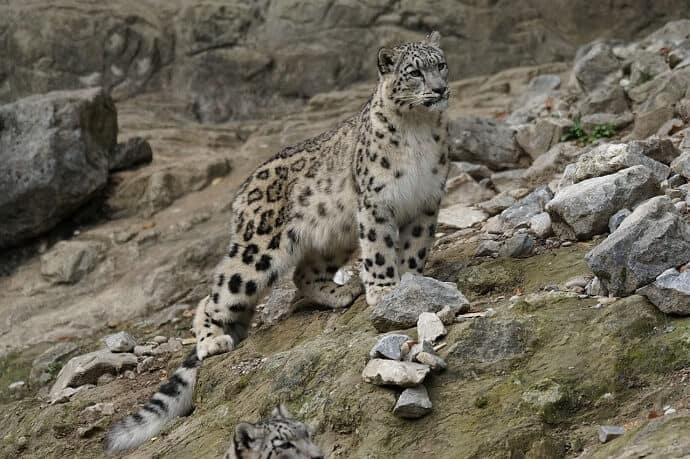
11. Snow Leopards live in some of the most harsh climate conditions on the planet, among the steep, rocky mountains of Central Asia (including the Himalayas). They inhabit primarily arid, barren slopes without any trees and sparse vegetation.
12. In the summertime, they migrate upwards in elevation, between 10,000 and 20,000 feet, which puts them far above the tree lines. In the winters, they might move as far down as 4,000 feet.
13. Snow Leopards live on only one continent: Asia. But they can be found in 12 countries, including Afghanistan, Bhutan, China, India, Kazakhstan, Kyrgyzstan, Mongolia, Nepal, Pakistan, Russia, Tajikistan, and Uzbekistan. Over 50% of the population is believed to reside in China.
14. Collectively, the Snow Leopard range covers over 750,000 square miles, which is roughly the size of Alaska and Texas combined. An individual leopard can have a range of nearly 400 square miles.
15. Within this space, Snow Leopards play a key role. Hunted by no other animals except humans, they indicate that the ecosystem is healthy. Apex predators like Snow Leopards keep prey numbers—often herbivores, but also smaller predators— in check, which prevents the vegetation from becoming too sparse and causing systemic problems.
READ MORE: Indian Animals (40 Species of Indian Wildlife)
Snow Leopard Diet
16. Snow Leopards are crepuscular, meaning that they are most active at dawn and dusk. They are opportunistic hunters, willing to adapt to whatever prey is available in abundance. They are the only species of big cat that will do this.
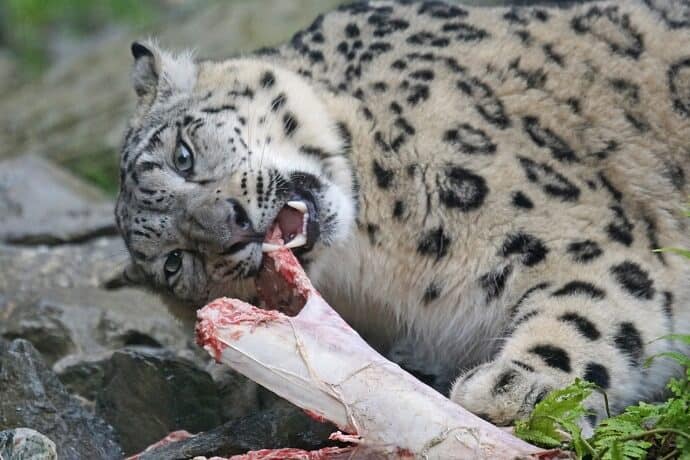
17. That being said, the preferred Snow Leopard prey is typically large herbivores, such as Mountain Sheep, Ibexes, and Goats. These cats can take down animals three times their weight. When pressed, they’ll go for smaller creatures like Rabbits, Voles, and Marmots. They’ll even hunt birds in a pinch.
18. Snow Leopards generally hunt alone, expect for occasional hunting pairs during mating season. Their hunting ranges can cover as little as 20 square miles in places with plenty of prey, or encompass close to 400 square miles where food is harder to come by.
19. Snow Leopards prefer to stalk their prey from above and chase them down slopes. They have very powerful legs, and are able to leap some 50 feet long and 20 feet high while using their elongated tail for balance. This makes them highly skilled and efficient hunters.
20. Snow Leopards average about one big kill every week or two. They are slow eaters, so a successful hunt is likely to last for days. During this time, they are prone to storing their food in snow tunnels.
21. Unlike other big cats, the diminutive Snow Leopard is not known to be aggressive over its kills. When challenged by other predators, they’re likely to back away and forfeit a meal. They will do the same towards humans. In fact, when humans are around, Snow Leopard behavior will change: They may even become nocturnal in order to avoid confrontation.
READ MORE: Amazing Animal Facts, From A to Z
Snow Leopard Babies/Mating
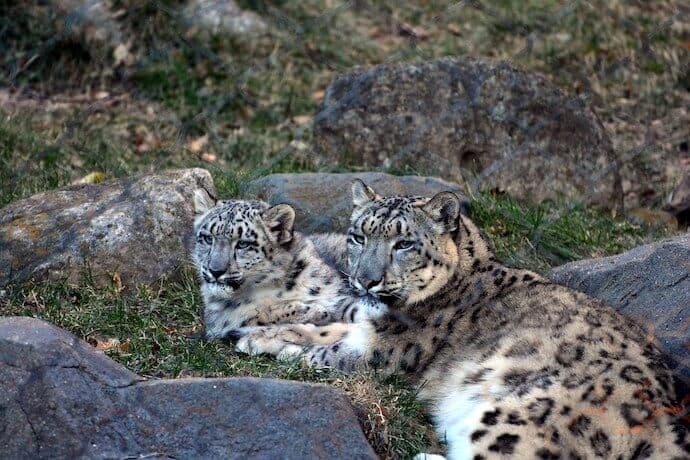
22. Snow Leopards are such solitary creatures, they don’t have a collective noun to describe a group of them. Adult males are complete loners, and only socialize during mating season. Females may stay with their cubs for up to 22 months.
23. Mating season is from January to March, and the lead-up to Snow Leopard reproduction can be a drawn-out affair. During this time, both males and females leave scent marks to guide mates into their territory. The courtship ritual includes calls and visual displays to indicate commitment to each other. Ultimately, the couple will even hunt together for a few days while mating occurs.
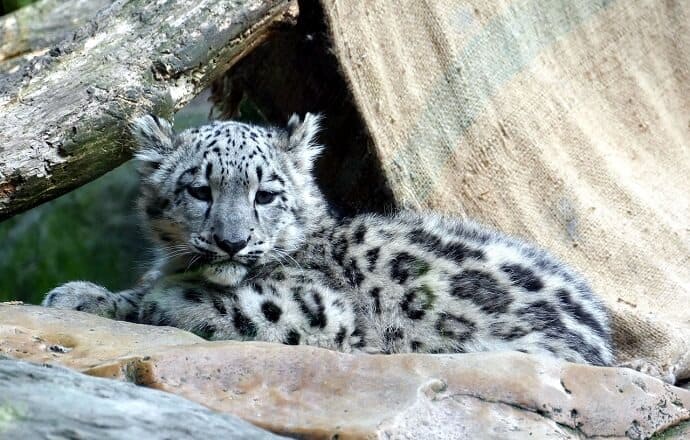
24. These brief romances are followed by a gestation period of 3 to 4 months. During this time, females will seek out a sheltered rock crevice for safety during the birthing process, as well as the infancy of the Snow Leopard babies. Mothers may give birth to up to 5 cubs, but the average number of cubs per pregnancy is two.
25. Newborn Snow Leopard cubs only weigh about a pound, are very reliant on their mothers for protection and food. Baby Snow Leopards don’t open their eyes for a week, and they don’t walk for five weeks. They do develop quickly, though: At two months they can eat solid food, and by three months they’re following their mothers around to learn important life skills, like hunting.
26. Mother Snow Leopards look after their young for about two years, after which the siblings will depart, typically staying together for a while longer. By the age of three, females are ready to have cubs of their own, but males don’t reach maturity until they’re four years old.
27. In the wild, Snow Leopards have a life expectancy of around ten years, but it’s not atypical for them to live up to 15 years. In captivity, these big cats can last over 20 years.
READ MORE: How Zoos Help Conserve Endangered Species
Why Are Snow Leopards Endangered?
28. The good news is that Snow Leopards aren’t technically endangered anymore. They’re now classified as “vulnerable” by the IUCN. Species that are vulnerable are, in essence, those moving towards the endangered list, effectively putting them at “high risk of extinction in the wild” as well. However, vulnerable is the organization’s least at-risk classification of threatened animals.
29. The wild population of Snow Leopards is somewhere in the range of 4500-8000, with another 600-700 living in captivity. That being said, the population is very difficult to track due to their expansive range and challenging habitat. But it is believed that the wild population is in decline.
30. Habitat fragmentation is a serious problem for Snow Leopards. Because they’re such wide-ranging creatures, human settlements and grazing land (for domesticated animal) often lead them into conflict. This interferes with the species’ hunting grounds, breeding, and homes. The places where most of these animals live are fairly concentrated and prone to human development.
31. There ‘s only one Snow Leopard predator– humans. As their habitat is encroached upon by human development, their sources of food dwindle and they prey on domesticated animals. When they hunt Sheep, Goats, Horses, and young Yaks, farmers often kill them in retaliation.
32. Because they have beautiful and thick pelts, which makes them a commodity in the illegal wildlife trade, Snow Leopard hunting is a problem as well. Their bones are also used as substitutes for Tiger bones in traditional Asian medicines. Recent reports have indicated that poaching is still a very serious issue for Snow Lopard conservation, with several hundred cats killed each year.
33. The largest long-term threat to Snow Leopards may be climate change. Habitat loss and hunting have knocked out approximately 20% of the population in the last decade. But climate change could alter the landscape and weather of Snow Leopard habitat, and would also create challenges for the prey it relies on for food. According to WWF studies, the regions most likely to be affected are in the northern and eastern reaches of its range, where an estimated 50% of all wild Snow Leopards live.
READ MORE: How Palm Oil Deforestation Contributes to Climate Change
Snow Leopard Conservation
34. The Snow Leopard Project, which was founded in 1998 by Shafqat Hussian, is a conservation effort in Pakistan aimed at preventing retaliatory hunting. If farmers lose their livestock when it’s preyed upon by the big cats, the Snow Leopard Project compensates them in order to ensure that conservation continues to make fiscal sense for the people who coexist with these animals.
35. Snow Leopard Trust, which is headquartered in Seattle, works in several of the animal’s native countries, including China, India, the Kyrgyz Republic, Mongolia, and Pakistan. Over 75% of the world’s Snow Leopards are located in these countries. The NGO focuses on protecting the animals by working with local communities on conservation projects. They also conduct scientific research in order to better understand their needs, habitats, and other characteristics.
36. Snow Leopard Conservancy is another US-based non-profit, this one operated out of California. It was founded in 2000 and works in seven different countries, cooperating with local communities to provide environmental awareness and stewardship training for young children and herder communities. This NGO focuses on education and land conservation on behalf of the Snow Leopard.
37. The Global Snow Leopard & Ecosystem Protection Program is a large-scale effort amongst all of the countries where Snow Leopards live in the wild. Their main mission is to identify and secure no less than 20 different landscapes, each with at least 100 breeding-age Snow Leopards. It’s called “Secure 20 by 2020.” To help with the effort of the 12 countries within the species’ ecosystem range, five Global Support Components have been developed to aid in dealing with international borders, law enforcement, industry, research, and knowledge sharing.
38. World Wildlife Fund is also working to protect Snow Leopards. In 2012, the organization (working in conjunction with USAID) initiated a four-year project aimed at conserving Snow Leopard habitat, as well as promoting water security and preparing high mountains communities for climate change. Additionally, WWF works with goat herders in Mongolia, reducing retaliatory killings by instituting livestock insurance plans.
39. TRAFFIC, an NGO that works to prevent animal poaching, has studied the illegal trade of Snow Leopard pelts and bones. According to TRAFFIC’s recent report, “An Ounce of Prevention: Snow Leopard crime revisited,” they found that hundreds of these cats have been recently killed, despite there being only a few thousand left in the wild. TRAFFIC’s analysis is being used by WWF, GSLEP, and the Snow Leopard Trust in their efforts to protect these animals and their habitat.
40. All of these fascinating Snow Leopard facts may have readers yearning for a close encounter with the cat. But odds are that the zoo is likely to be the only place for this. Known as “ghosts of the mountains,” Snow Leopards live in such remote spots, have such great camouflage, and are so elusive that even catching them on a camera trap is cause for celebration. But the Snow Leopard Trust has a Natural Partnerships Program with zoos around the world, involving them in conserving the most at-risk Snow Leopard populations. –Jonathon Engels